Display
Always-on article display.
A slow, full-article loop for a TV, lobby screen, or open browser. Tag posts with display to curate this stream.
Spectral Residue
Independent. Contributor run. Reader first.
No display-tagged posts yet. Showing the latest published work.Refreshes every 60 min

Graduation Weekend 2026
Student Data Privacy Is a Human Right in Higher Education
COMP 2300 Winter 26 / Makda Gorfu
Every day, college students share personal information without realizing how much is being collected. From online learning platforms and campus apps to social media and browsing habits, student data is constantly tracked, stored, and sometimes sold. While technology has improved access to education, it has also created serious risks to privacy.
Colleges must improve protections, require transparency from technology companies, and educate students about how their personal information is used.
Why Student Data Privacy Matters
Most students are not fully aware of how much information is collected about them or who has access to it. As technology continues to expand in education, the risks connected to personal data misuse are growing. For this reason, data privacy should be treated as a basic human right in higher education.
Data privacy refers to how personal information is collected, stored, and shared by organizations. It focuses on protecting individuals from having their data misused or exposed without consent. Strong data privacy practices ensure that personal information is handled responsibly and that individuals have control over how their data is used.
This means organizations should only collect necessary information and clearly explain their policies. In higher education, however, many platforms collect more data than needed. Learning software tracks student behavior, online activity, and performance details. While some of this information can help improve education, much of it can also be shared or stored without clear limits, putting students at risk.
Students Often Cannot Opt Out
What makes this situation even more concerning is that students often have no real choice. To complete assignments, attend classes, and access grades, they must use these digital platforms, even if they are uncomfortable with how their data is collected.
Privacy policies are usually long, confusing, and rarely read, leaving students unaware of what they are agreeing to. If higher education continues down this path, students will graduate not only with degrees, but with permanent digital records that can be tracked, analyzed, and potentially misused for years to come. Strong privacy protections are not optional; they are necessary to ensure that education remains a place of trust, not surveillance.
Equity and Long-Term Risk
Beyond individual risk, weak data privacy practices in higher education raise serious ethical and equity concerns. Students from marginalized or low income backgrounds may be disproportionately affected when their data is collected and analyzed. Predictive analytics and tracking tools can reinforce bias by labeling students as “high risk” or “low performing” based on incomplete data, which may influence advising, financial aid decisions, or academic opportunities.
When personal data is used to categorize students rather than support them, it undermines the fairness and purpose of education. There are also long term consequences that extend beyond college. Data collected during a student’s academic career does not always disappear after graduation. Stored records can be accessed years later, potentially affecting employment, insurance, or other opportunities.
Students rarely know how long their data is kept or whether it can be deleted. Without clear limits on data retention, colleges contribute to a system where personal information follows individuals long after it is relevant.
A Campus Built on Trust
Protecting data privacy strengthens the relationship between students and institutions. Colleges are spaces where students should feel safe to explore ideas, express opinions, and make mistakes without fear of constant monitoring.
When privacy is respected, students are more likely to participate honestly and engage fully in their education. Treating data privacy as a human right ensures that technology serves learning rather than controlling it, preserving higher education as a space built on trust, autonomy, and respect.
This visual displays survey results showing that 91.1% of respondents believe prioritizing data privacy increases trust and loyalty, while only 8.9% disagree. The overwhelming majority demonstrates that people strongly connect privacy protection with confidence in organizations. This indicates that when personal information is respected and protected, individuals feel safer and more willing to engage with institutions.
This visual shows what actions consumers believe organizations should take to build trust when handling personal data. The largest portion of respondents selected providing clear information about how data is used, showing that transparency is the most important factor in building trust. This suggests that people want to understand what data is collected, why it is collected, and who has access to it.
Other major concerns include stopping the sale of personal information for advertising and ensuring responsible data handling, which shows that people are worried about their data being used for profit rather than protection. In higher education, this is especially important because students are often required to use digital platforms with little choice. These results show that colleges should clearly explain their data policies in simple language, limit unnecessary data collection, and prevent third party companies from exploiting student information.
Sources
Innovation Without Access: The Real Healthcare Technology Gap
COMP 2300 Winter 26 / Will Zuzic
With technology becoming more and more advanced, the world is quickly changing because of this. This is very much true in the healthcare and medical industries. Technologies such as AI-assisted diagnostics and robot-assisted surgeries are greatly changing the medical world, offering faster procedures and even more accurate diagnostics. Yet for most patients, these breakthroughs are out of reach.
Without a shift in prioritizing affordable and accessible healthcare technology, the gap between what technology is available and what patients are getting will continue to grow.
Because of the incredibly high costs and limited availability, a vast majority of people do not have access to cutting-edge medical equipment. As the price for proper healthcare continues to rise, healthcare officials need to allocate their resources wisely and towards different angles. Only technological innovation will not solve the growing costs and unaffordability of the healthcare industry.
The Access Problem
Already, access to healthcare is a great challenge to many Americans. According to a survey, over 35% of Americans struggle to afford healthcare, and around 11% of them are unable to afford it at all. When expensive technologies such as the devices currently being created are added to an already costly system, access will become even more limited.
The urgency is clear: the system is already so unaffordable that many Americans plead with others not to call an ambulance for them, fearing the bill more than the injury. Adding more expensive technology to this structure only intensifies the crisis. These advanced tools would only be available in large hospitals. Because of this, modern healthcare access will greatly depend on income, insurance, and distance. This will create disparities that undermine the benefits of innovation.
Costs Compound the Gap
These healthcare costs place a strain on both the patient and the hospital. According to data, the average American spends around $14,570 on healthcare a year. What is worse is that this number is expected to increase. This means higher insurance premiums and increases in out-of-pocket expenses. Expensive new technology increases these costs as providers expect a higher profit return when spending millions on technology.
Prevention Should Count as Innovation
Another factor that we must consider is the rise of chronic illnesses. Both diabetes and heart disease are becoming more and more common, now affecting over half of adults in the United States of America. In fact, these two chronic illnesses are responsible for over 90 percent of the US’s healthcare spending.
Creating affordable and new technologies focusing on the prevention and treatment of these illnesses could greatly improve people’s health more than a 10-million-dollar robot ever could. Currently, the tools used to prevent these are inaccessible due to cost, leaving people with fewer options to maintain their health.
Who Can Change This?
The main people with the power to address this issue are healthcare policymakers and administrators. These people are the ones who decide where most of the major funding goes. Too often, it goes towards expensive cutting-edge technology when the market is also in need of affordable, easily accessible tech.
Another potential solution is to require major hospitals to balance their investments between high-cost innovation and affordable community-based care. For every multi-million dollar purchase of a cutting-edge device, there should also be a focus towards preventative screening and subsidized treatment.
There should also be policies in place requiring hospitals to report how new technologies will affect pricing, allowing communities to see if these machines will actually improve the community or not. While hospitals compete to adopt new technologies, they should also be competing to try to make the most affordable care as well. By creating financial accountability, hospitals will be incentivized to try to lower the cost of healthcare within their own hospitals.
What Healthcare Innovation Should Mean
I believe that healthcare innovation shouldn’t be measured by how advanced medical technology becomes, but by how many lives it can save or improve. The US doesn’t suffer from a lack of incredible medical technology but from an unequal distribution of it.
If policymakers continue to prioritize new advanced technologies over accessible solutions, then the vast majority of the population will continue to have access to the same medical technology as costs rise and disparities deepen. On the other hand, if focuses begin to move towards accessibility and prevention, then the whole system will be strengthened rather than divided. Healthcare shouldn’t be focused only on those who can afford it, but for everyone.
Sources
Nuclear Energy Deserves a Second Chance
COMP 2300 Winter 26 / Rhys Jones
Most people my age care about climate change and clean energy. We support solar panels, wind farms, and electric cars. But when nuclear power comes up, the mood often changes.
People think of disasters, radiation, or nuclear weapons. I used to feel the same way. Nuclear just sounded risky and outdated. But the more I have learned, the more I think we need to take a second look at it, especially because of how fast our electricity demand is growing.
But the more I have learned, the more I think we need to take a second look at it.
AI Is Increasing Power Demand
AI is blowing up right now and every new AI tool, chatbot, and data center uses a lot of energy. “15 questions, 10 images, and 3 videos generated by AI can use as much energy as riding an e-bike for 100 miles.” We did the math on AI’s energy footprint. Here’s the story you haven’t heard.
As AI grows, so does the strain on the grid, and that electricity must come from somewhere. If it comes from fossil fuels, emissions go up, which hurts our climate goals and can raise energy costs.
If it comes only from renewables like wind and solar, there can be problems when the sun isn’t shining or the wind isn’t blowing. Batteries can help this issue, but they aren’t always enough for super large-scale, nonstop demand.
Why Nuclear Belongs in the Mix
I believe this is where nuclear warrants more attention. Nuclear energy is one of the few low-carbon sources that can produce large amounts of electricity 24/7. It doesn’t depend on the weather or emit carbon during operation. And modern reactors are built with multiple safety systems designed to prevent accidents.
But public stigma is still a huge barrier. Many people still associate nuclear power with Chernobyl, Fukushima, or bombs. These fears are understandable, but they don’t always reflect the true nature of nuclear power and how much technology and safety standards have improved. Today our reactors are very different from older designs, and safety rules are stricter than ever.
No Energy Source Is Perfect
Other energy sources also have downsides. Huge wind farms affect landscapes and local climates. Solar needs lots of land and materials. No energy source is perfect, which makes the real question to our problem: which mix of energy sources gives us reliable, low-carbon power?
It appears we act like nuclear and renewables must compete, but in reality they can work together. Renewables can handle variable generation, and nuclear can provide steady baseline power.
I am not saying that we should build a bunch of nuclear plants everywhere without thinking. Safety, waste management, and cost all matter. Communities deserve a say in the matter. But rejecting nuclear power completely because of fear or old perceptions could limit our options at a time when we need cleaner energy, not fewer choices.
Demand Is Not Waiting
If AI, electric vehicles, and modern technology keep growing at our current pace, the electricity demand will grow with them. Ignoring that reality will not make it go away. Waiting until blackouts or price spikes happen will only make solutions more expensive and rushed.
Global power demand will continue to grow rapidly over the next decade, jumping about 30% by 2035.
For students, voters, and everyday people who care about clean energy, it might be time to update how we think about nuclear technology. We need to look at it as a tool in a larger clean energy tool kit.
“The U.S energy mix today is still dominated by oil and natural gas, which together make up over 70% of domestic energy production.” U.S. Energy Mix iea.org. The future grid will probably need a mix of wind, solar, hydro, good storage, and nuclear power.
The goal of this writing is not to win an energy debate, but to keep our lights on without abusing our planet. I believe nuclear can help us do that safely, and at least deserves to be talked about.
Media Note
I’ve lived on Maui for the past four years!

Beneath the Game: Why the NFL Must Replace Turf with Natural Grass
COMP 2300 Winter 26 / Myles Durant
Earlier this fall, when Bengals franchise quarterback Joe Burrow limped off the field with turf toe, it wasn’t the result of an awkward tackle or a dirty hit. It was the playing surface beneath him.
In recent years, NFL fans have watched some of their favorite players suffer non-contact lower-body injuries that have the potential to derail seasons and alter careers. In a league built on speed, jukes, and explosive movement, the ground players stand on matters more than we seem to acknowledge.
In a league built on speed, jukes, and explosive movement, the ground players stand on matters more than we seem to acknowledge.
While injuries are inevitable in professional sports, growing evidence suggests one factor is making them more likely: artificial turf. Research shows that lower-body injuries, especially non-contact injuries like ACL tears and foot injuries, occur more frequently on turf. If the league truly prioritizes player safety, it can no longer turn its back on this issue.
The decision is clear: the NFL should require all stadiums and practice facilities to use natural grass instead of artificial turf.

What the Injury Data Shows
In 2024 the Orthopaedic Journal of Sports Medicine conducted a study that found significantly higher rates of lower-extremity injuries on artificial turf than on natural grass. Notably, non-contact injuries were particularly more common. This is no coincidence. These kinds of injuries reflect measurable biomechanical differences between surfaces.
Artificial turf is stiffer than natural grass and creates greater rotational resistance when players plant and cut. If you’ve ever watched a football game, you know that ball carriers and tackler positions are doing this constantly. During these rapid changes of direction, turf often increases the torque placed on the knee and ankle joints.
Natural grass, however, allows some give and release where synthetic turf would otherwise cling onto cleats. That added resistance increases ligament stress and raises the risk of injuries like ACL tears.
Players Are Asking for Change
Of course, this issue goes far beyond just keeping the fans happy. NFL players themselves have voiced their dissatisfaction. The NFL Players Association has repeatedly advocated for a league-wide shift to natural grass, arguing that turf is harder on the body and contributes to preventable injuries.
When the athletes whose careers depend on their physical health are calling for change, the league should listen. Some players work their entire life just to earn a spot on the practice squad. How agonizing must it feel to have that opportunity taken away by an injury that could’ve been prevented?
The Business Case
If player safety isn’t enough to push the needle, we can also take a more economic approach. The NFL strategically markets its biggest stars like franchise quarterbacks, elite wide receivers, and pass rushers. Teams invest in these athletes often to the tune of nine-figure contracts.
When a star suffers a season-ending injury, the ripple effects are devastating to their team’s season. Playoff hopes tank, fan engagement plummets, and the overall product suffers. As a result, the financial implications of losing even one key player can far exceed the annual expense of maintaining natural grass.
The Turf Argument
The main argument against a leaguewide switch to natural grass is that artificial turf is more durable and easier to maintain, especially in multi-use stadiums that host other events such as concerts. Additionally, turf performs consistently in harsh weather conditions and does not require the same level of upkeep as grass.
These are valid claims. However, convenience should not outweigh player safety, especially concerning a league that generates more than a whopping $20 billion annually.
A Standard Other Sports Already Use
Other prestigious global sports organizations have already taken action to protect their players. FIFA will be requiring all stadiums hosting the 2026 World Cup to use natural grass, even if they currently operate with turf.
The NFL is prepared to revert all its affected stadiums back to turf after the World Cup has concluded. As it does so, it will be hard not to wonder: if the world’s grandest sporting event demands natural grass for performance and safety reasons, why doesn’t the NFL?
The League Has the Power to Act
Of course, football is inherently physically demanding and switching to grass will not eliminate injuries entirely. However, reducing entirely preventable risk should be the league’s responsibility. With the data staring executives in the face, every ongoing game and practice without change is a liability.
The league often emphasizes its commitment to safety with acts like updating concussion protocols, adding guardian caps, and adjusting rules to protect quarterbacks. Mandating natural grass would align with those efforts. It would show genuine care to player safety and remove doubts about performativity.
Fans deserve to see the best athletes competing at full strength. Players deserve a surface that does not increase their risk of injury. And the NFL, with its abundance of resources, has the power to make this change. The future of the league couldn’t be any clearer.
Works Cited
- Bell, Jarrett. “NFL Grass vs. Turf Stadiums: Playing Surface Standards Questioned Ahead of 2026 World Cup.” USA Today, 8 Jan. 2026. https://www.usatoday.com/story/sports/nfl/columnist/bell/2026/01/08/nfl-grass-vs-turf-stadiums-playing-surface-standards/87687167007/.
- Gould, H. P., et al. “Lower Extremity Injury Rates on Artificial Turf Versus Natural Grass Playing Surfaces: A Systematic Review.” PubMed, 2023. https://pubmed.ncbi.nlm.nih.gov/35593739/.
- Mack, Christopher D., et al. “Lower Extremity Injuries in the National Football League: Artificial Turf Versus Natural Grass.” Orthopaedic Journal of Sports Medicine, 2024. https://pmc.ncbi.nlm.nih.gov/articles/PMC11363235/.
- National Football League Players Association. “Only Natural Grass Can Level the NFL’s Playing Field.” NFLPA. https://nflpa.com/posts/only-natural-grass-can-level-the-nfls-playing-field.
AI is a Bubble Doomed to Pop
COMP 2300 Winter 26 / Elle Hubert
We exist in a system where the main driving force is profit. These corporations are performing a balancing act between profit and optics.
Their negative effects are hard to measure, relatively easy to look at, and they are protected by the allure of the future.
The only reason that large companies don’t operate entirely off of slave labor is that it would reduce their bottom line. AI companies have a number of benefits that past companies have not. Their negative effects are hard to measure, relatively easy to look at, and they are protected by the allure of the future.
In ethical terms, AI fails on almost every metric. It is a tool that damages the environment, steals work from artists, and has the capacity to result in horrible tragedies, such as the suicide of a minor after engaging in sexual chats with a chatbot. Quite simply, AI has no moral ground to stand on as a technology.
Yet, because it profits, it is allowed all these things and more.
The point of this paper is not to argue against AI in an ethical sense. It is to argue against it in an economic one.
Nvidia
Nvidia, the self-proclaimed world leader in AI computing, currently makes up 16.2% of the GDP of the United States. It currently has a valuation in the trillions (yes, trillions with a T).
This is a massive amount of money, but the question has to be asked: where does it come from?
Compared to the rest of the companies on this list, Nvidia doesn’t have a store you can go to and buy things or products you see on the street: Nvidia makes computer chips, of which half go to only three customers. One of which is almost certainly…
OpenAI
And their new invention, a burning pile of money!
Nvidia has a lot of business with OpenAI. AI is the future, and Nvidia makes the highest quality materials. As long as OpenAI has money, Nvidia will sell them chips. Speaking of, let’s look at OpenAI’s money.
At first glance, this looks pretty good. 20 billion a year, directly correlating with spending? This is an investor’s dream. Except: this is a revenue graph, not a profit graph. Meaning, this graph doesn’t take into account all the money they spent.
20 billion a year? Try 143 billion NEGATIVE before making a single dollar of profit. And that’s not even close to what OpenAI has pledged to spend over the next decade. To put this in easier numbers to grasp: this is the same as spending 100 dollars over the next ten years for my company that has an annual revenue of $1.27, and has already spent $6. There is simply never a situation where this return on investment is matched.
This is why Nvidia has such a high valuation: any company would have it with the knowledge that you will receive a significant portion of a trillion dollars over the next decade.
Aside from this, OpenAI doesn’t seem to know a lot about their business model, or their customers (or, as it is beginning to seem, much of anything at all outside of making neural networks and generating hype). With the aforementioned ethical dilemmas (and many, many more…) surrounding AI, there is a solid amount of the global population determined to never use or spend money on it.
Assuming they had the entire world using it, with the current rates of people actually paying? They’d make 8.3 billion dollars per month… So only what, eleven years to start making profit?
Too Big to Fail
What happens when the bubble pops?
The term “Too big to fail” doesn’t mean that something can’t fail. It means that it cannot be allowed to fail. All possible action must be taken to prevent the bubble from popping. But it will.
At a certain point, AI will no longer be an unshakable certainty: it will be a financial novelty, on the level of NFTs. Investor opinion will turn, OpenAI will go under, and without it? Nvidia falls, not entirely, but still, leaving a loss of GDP not seen since the global pandemic.
Part of the reason that the 2008 financial crisis was so devastating was that there was no warning, there was nothing we could have noticed. Except there were. They were there, plain as day, and nobody did anything until it was too late. This is the same. We know this is happening, that it must happen. Better it happens within our control than without.

Prompting with Precision: Better Inputs, Better AI Output
COMP 2300 Winter 26 / Cooper Livingston
This week made it clear that communication quality matters more than tool quality. AI can generate a lot quickly, but unclear prompts usually produce vague output that still needs heavy editing.
AI can generate a lot quickly, but unclear prompts usually produce vague output that still needs heavy editing.
This Week
I practiced writing shorter, specific prompts with context and constraints. That reduced rewriting time and made responses much closer to what I needed for class discussions.
Media Check
Next Up
My next goal is to build a repeatable prompt template for reading responses and compare consistency across assignments.
Focus by Design: Reducing Digital Distraction
COMP 2300 Winter 26 / Cooper Ade
I started the semester by paying attention to how often technology shapes my focus, not just my schedule. Small tools like calendar reminders and note apps help, but constant notifications can still fragment work time.
I started the semester by paying attention to how often technology shapes my focus, not just my schedule.
This Week
The best change I made was using two dedicated study blocks with my phone on Do Not Disturb. I finished tasks faster and had a clearer idea of what I actually learned versus what I only skimmed.
Media Check
Next Up
I want to keep the same routine and measure whether this structure improves assignment quality over the next two weeks.
AI: Hidden Opportunities
COMP 2300 Winter 26 / Cody Kern
As we start to work our way through another revolution, it is natural to feel a bit uneasy. Similar feelings arose in every revolution that we, as a species, have been through up until now.
The biggest need that should be the point of concentration is the need for some sort of regulation.
Why AI Feels Unsettling
It is simply human nature to feel uneasy while watching things become more autonomous. It happened during the industrial revolution as well. One thing I would like to point out is that we have also learned to adapt to these revolutions and learned to live with them.
If we look at the history of our media, it is not hard to see why AI would be something we have learned to fear. Movies like The Matrix and Eagle-Eye show us what happens when Artificial Intelligence gets way too out of hand.
Something that should be kept in mind is the difference between Artificial Intelligence and sentience. The AI that we use to automate our everyday life seems like it has all the elements of intelligence, but it simply is not.
The Case for Regulation
In fact, the biggest need that should be the point of concentration is the need for some sort of regulation on AI to stop companies from pushing out every automated service they possibly can.
Not only is this the main cause of concern for the environment, but also for the type of information that is being dispersed. Two examples of not having regulations are AWS and IBM; both companies are leading suppliers of AI-driven technologies, including commercial AI chatbot tools such as Amazon Lex. They promote convenience while providing less information about water usage impacts and alternatives. Something like this could become more common if there is not regulation.
As we can see in the table above, unregulated AI usage is a problem. China’s president Xi Jinping has been the first to propose a global regulation AI hub in Shanghai. Without proper regulation of AI, we will continue to see AI fail to live up to its potential. Even less, if companies just see it as an easy way to minimize costs and maximize profit.
Bias, Access, and Better Use
Artificial Intelligence uses what is called a Large Language Model and has been used by the government since as far back as the 50s. With the first chatbot around 1966, these models inherited human biases. Meaning that a lot of the misconceptions that have been developed over humans’ existence have also been coded into these models.
This would only go to show just how easily information, and quite frankly AI in general, could continue to become just another useless tool that ends up being more like the movie Idiocracy.
The best and most important thing to prevent this future is to avoid becoming overly reliant on AI. We should be pushing for full support of AI regulation from all levels of the AI community. This includes lawmakers. Regulation could, in fact, calm a lot of the concerns surrounding the level to which people are using AI.
We should be teaching people how to use AI critically and learn how to collaborate with technology and information, instead of trying to use it to further the gap between classes.
If we consider communities that may not have access to information outside of an internet connection, AI gives information to those communities. However, the importance should not be on the abandonment of AI. Instead, the focus of AI should be on making it the best version possible.
According to The Commonwealth Institute’s article “Unequal Opportunities,” students in Virginia’s high-poverty areas only have access to a third of fully accredited schools that offer the proper courses. Compared to low-poverty students, where almost all schools are fully accredited by the state, this shows how unequal educational access can become.
Focus
It’s important to remember not to become overly reliant on AI, as this could continue to push the state of AI further away from what makes it truly a powerful tool. That is, if we can push for a more regulated form of AI so that we can teach it, and it can teach us, creating a more collaborative environment.
Connecting information from the world’s greatest minds to higher poverty areas could eventually help us use AI as a collaboration partner. It could even help us learn to create a more balanced, unbiased justice system, or a fair, equal health care system.
This would require what is known as Artificial Generative Intelligence, which would still be a far-off expectation with the current state. Currently, Artificial Intelligence will only be as smart and capable as the information that is provided to it. Until then, it is important to understand how to use AI to teach you rather than having it solve the problem for you.
AI can potentially help close the gap that is seen between high-poverty and low-poverty communities. If we use the examples of how we have had AI in our media and learn from those mistakes, then we need to start considering who can distribute what types of AI.
Forcing leading producers of AI services, such as AWS and IBM, to put out better and more efficient systems while looking for other alternatives could take some of the pressure off the data centers.
Media Sample
Sources
- Starter post: starter_post.md
- Video link: youtube.com/watch
The Digital Expiration Date: Why Your Tech Has a Kill Switch
COMP 2300 Winter 26 / Charlie Shields
In my drawer sits a 30 year old Game Boy that still boots up and works perfectly. Right next to it is a smart home hub I bought to control some LED lightbulbs. It is barely three years old but now has as much functionality as a bag of bricks.
One runs Tetris without complaint; the other cannot even blink its lights. The Game Boy was not built with superior technology, it just is not on a leash. Our technology is not breaking, it is being broken on purpose.
Unbeknownst to many, we have entered a strange era where buying a product no longer means you own it. As a recent example, Spotify “remotely detonated” the Car Thing, a portable device people paid $90 for. Spotify told them to just dispose of it, as if it was no longer their problem. $90 down the drain because Spotify did not want to pay to keep the servers up.
One runs Tetris without complaint; the other cannot even blink its lights.
The Illusion of Ownership
We are letting corporations use terms of service to override our actual property rights. As author Cory Doctorow famously puts it: “if buying is not owning, then piracy is not stealing.” Beyond the breach of consumer rights, we are witnessing a massive, manufactured waste of perfectly functional technology.
When a company bricks a device, they are not just deleting code. They are sabotaging our ability to reclaim incredibly valuable materials. This makes it nearly impossible to wipe data for reuse or safely disassemble parts for recycling.
The Hidden Goldmine in Our Trash
From a global perspective, this is a massive waste of perfectly functional computers. While a study from the Yale Center for Industrial Ecology shows that total e-waste mass is declining, the complexity of what we are throwing away is becoming a bigger problem. We are discarding rare materials like cobalt and indium. These are resources that are becoming increasingly concentrated in our waste stream as we move toward mobile devices.
The irony is that we actually have the resources to be sustainable, it is just all sitting in our landfills. Visual 3 in the Yale study compares the raw materials needed for new electronics against the amount sitting in our discarded e-waste. By 2018, for materials like gold and indium, the amount we were throwing away actually surpassed what we needed to build new devices.
We have reached a point where we could theoretically stop mining the earth and just reuse what we already have.
But this renewable potential is not possible if we continue the wasteful cycle that hardware locks create. When a company bricks a device, they are sabotaging our ability to reclaim those incredibly valuable materials. Locked software makes it harder to wipe data for reuse or disassemble parts for recycling.
The Corporate Defense
Critics and tech manufacturers argue that maintaining software for “legacy” devices is a security risk and a financial burden. They claim that bricking a device like the Car Thing is a necessary step to protect user data and prevent the unused hardware from becoming a gateway for hackers.
However, we believe that if a company can no longer afford to support a device, they should not be allowed to kill it. They should be required to open it.
The Legal Solution
We need a legal “Sunset Clause” to solve this problem legally. If a company stops supporting a product, they should be required to release the final firmware and unlock the bootloader.
Essentially, if they stop supporting it, they must immediately hand over the keys so we can run the hardware ourselves instead of watching it become e-waste. It is time for laws that protect the consumer, the planet, and the very idea of ownership.
Sources
- Welch, Chris. “Spotify is going to break every Car Thing gadget it ever sold.” The Verge, May 23, 2024. This is the primary reporting on the event. It confirms that users were told to “dispose” of the device with no option for a refund or open-source software.
- Doctorow, Cory. “If buying is not owning, piracy is not stealing.” Pluralistic, December 8, 2023. From Doctorow’s daily blog, this is the most direct source for the “End of Ownership” argument. It explains how “terms of service” are used to override property rights.
- Yale Article: “Electronic waste on the decline, new study finds.” This study provides statistics on how electronic lifespans are changing and impacting the waste stream.
- Journal of Industrial Ecology metadata: “The evolution of consumer electronic waste in the United States.”
Automated Inequality: AI in Tech Recruiting
COMP 2300 Winter 26 / Anisha Arumilli
If you work in HR or in college admissions, you’ve probably started to love your job now that automated screening tools have taken the grunt work out of reviewing hundreds of resumes and applications.
They screen resumes in seconds, flag the most qualified candidates, and organize applications neatly. But they also filter out voices and perspectives that could change the company for the better.
Automated systems can make bias more consistent instead of making hiring more fair.
How Automated Screening Works
AI makes hiring decisions by identifying patterns in past recruitment data. It analyzes resumes and applications to find traits common among previously successful candidates, then finds new applicants who match those traits.
This seems like the perfect way to speed up recruitment, but AI hiring tools are only as fair as the data they’re trained on. Even when they appear objective, they can replicate or amplify existing biases.
Bias in the Training Data
Amazon discovered this with an AI recruiting tool trained on resumes from its mostly male workforce. The system began penalizing resumes that mentioned “women,” reinforcing the same demographic patterns that already existed rather than correcting them.
These patterns often come from human hiring decisions that contain both conscious and unconscious bias. Research published through VoxDev in May 2025 found that AI hiring tools systematically favored female applicants over Black male applicants with identical qualifications after learning patterns from biased historical hiring data.
Instead of making hiring more efficient, the technology just makes bias more consistent.
When the System Scores People Incorrectly
Bias can also appear in AI systems when the training data doesn’t capture the full diversity of people it evaluates. HireVue’s AI video interview system, used by over 1,000 companies including JPMorgan Chase, Goldman Sachs, and Amazon, has been shown to score non-white and deaf applicants lower because it was trained mostly on data from white and hearing candidates.
It misinterprets accents, speech patterns, and facial expressions it hasn’t seen before, giving these applicants lower scores.
Even when AI systems are built to be neutral, human bias can slip in through the structure of the system itself. The University of Texas at Austin used a machine-learning system called GRADE to evaluate candidates for the PhD in CS program which was found to systematically reject women and POC while favoring white men.
Letters of recommendation are influenced by social bias, often describing women as “caring” and men as “assertive” or “outstanding.” GRADE, trained on these letters, favored the language more often used for men, which led it to select more men.
Why Diversity Changes Outcomes
These biases affect more than individual applicants. Reduced diversity can limit collaboration and problem-solving because teams lack a wide range of perspectives and experiences. Over time, workplaces and academic programs become less adaptable and less innovative, reinforcing structures that favor only certain groups (Forbes).
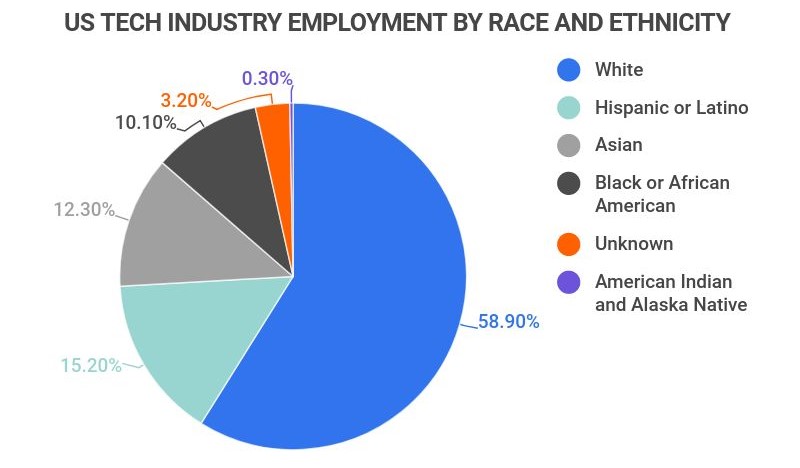
The lack of diversity in tech is already creating real harm in the systems we use every day. When the people developing algorithms and AI systems do not represent the diversity of the people who will use those systems, we get facial recognition that fails to identify Black faces accurately.
We get health apps that ignore medical conditions primarily affecting women and people of color. We get voice assistants that fail to recognize accents from non-native English speakers.
The Feedback Loop
As organizations and universities rely more on automated systems, applicants are adjusting to fit the patterns these tools favor. Resumes and applications increasingly emphasize keywords, phrasing, and styles that AI systems recognize as “ideal,” and some students even turn to AI tools to help craft their submissions.
This behavior creates a feedback loop where AI not only filters candidates but also shapes how candidates present themselves, narrowing the range of experiences, perspectives, and approaches that are considered desirable.
Just as these automated systems become standard across universities and companies, we’re watching DEI initiatives get scaled back or eliminated entirely. IBM, Meta, and numerous other companies have rolled back diversity programs and universities are cutting similar initiatives.
The very programs designed to counterbalance structural inequities and create pathways for underrepresented students are disappearing right when automated screening is becoming more normalized. We’re eliminating the programs meant to counteract bias while encoding that bias into our hiring systems.
What Organizations Should Do
Companies and universities must adjust their screening systems to ensure equality. If you’re using AI to filter applications, you should know exactly what criteria it’s using and whether those criteria are actually predicting success or just replicating who you’ve historically hired.
You should be testing whether candidates from different backgrounds are being screened out at different rates, and if they are, you need to fix it or stop using the system entirely.
This means questioning whether the algorithm is actually assessing what you think it’s assessing. A 3.8 GPA isn’t necessarily more impressive than a 3.3 from a student who worked thirty hours a week to pay for school. The algorithm doesn’t know the difference, but companies should. Humans must be involved to contextualize these metrics and evaluate the full picture.
Some companies will say they can’t afford to review applications manually, that they receive thousands of resumes and need automation to manage the volume.
But if your screening process is systematically excluding talented people, you’re not actually managing anything efficiently. You’re just automating discrimination at scale. The question isn’t whether you can afford to review more applications carefully. It’s whether you can afford to keep missing the candidates who could actually solve your hardest problems.
The solution isn’t to abandon technology entirely. Keep humans in the decision-making process and continuously measure outcomes. Track who advances, who is filtered out, and whether the people your system selects actually succeed.